

Primally Pure Just Dropped Two Tinted Mineral SPFs: A Formula Audit
Primally Pure just dropped two tinted mineral SPFs — a Lip + Cheek Tint SPF 15 and a Sun Serum Tinted SPF 30 — and the ingredient lists are the cleanest I have seen in the category. Extremely excited that this brand is making it’s debut into makeup, so I ran both formulas through the four-pillar Fair Marrow framework: Ingredients, Sourcing + Manufacturing, Third-Party Testing, and Customer Service. Two of those pillars came back strong. One came back open. And one came back with a real asterisk I want you to see before you buy.
This is a formula audit, not a worn test. The lipsticks and the serum just shipped. I have not tested either on my own skin yet, and a worn-test follow-up is on the calendar for late summer. So today is about what the INCI says, what the brand discloses, and what the brand still has not put in writing.
The Brand’s Claim
Primally Pure positions these two SKUs as ancestral, animal-based, mineral-only makeup for daily wear. Per founder Bethany McDaniel’s Substack post on the launch, the brand spent “well over a year” iterating on both formulas — “honestly, too many to count” versions of the serum alone — before landing on the final texture and shade range.
The brand’s own framing: “mindfully formulate ancestral, animal-based formulas for modern, daily rituals.” The Sun Serum’s pitch is that it is “so much more than just SPF with color” — antioxidants, a retinol alternative, barrier-friendly fats, and broad-spectrum mineral protection in one step. The Lip + Cheek Tint is described as “a creamy, multi-purpose stick made with biocompatible fatty acids, skin-nourishing antioxidants and a mineral tint complex.”
So far so good. Now the ingredient panel.
 The Ingredient Audit — Lip + Cheek Tint SPF 15
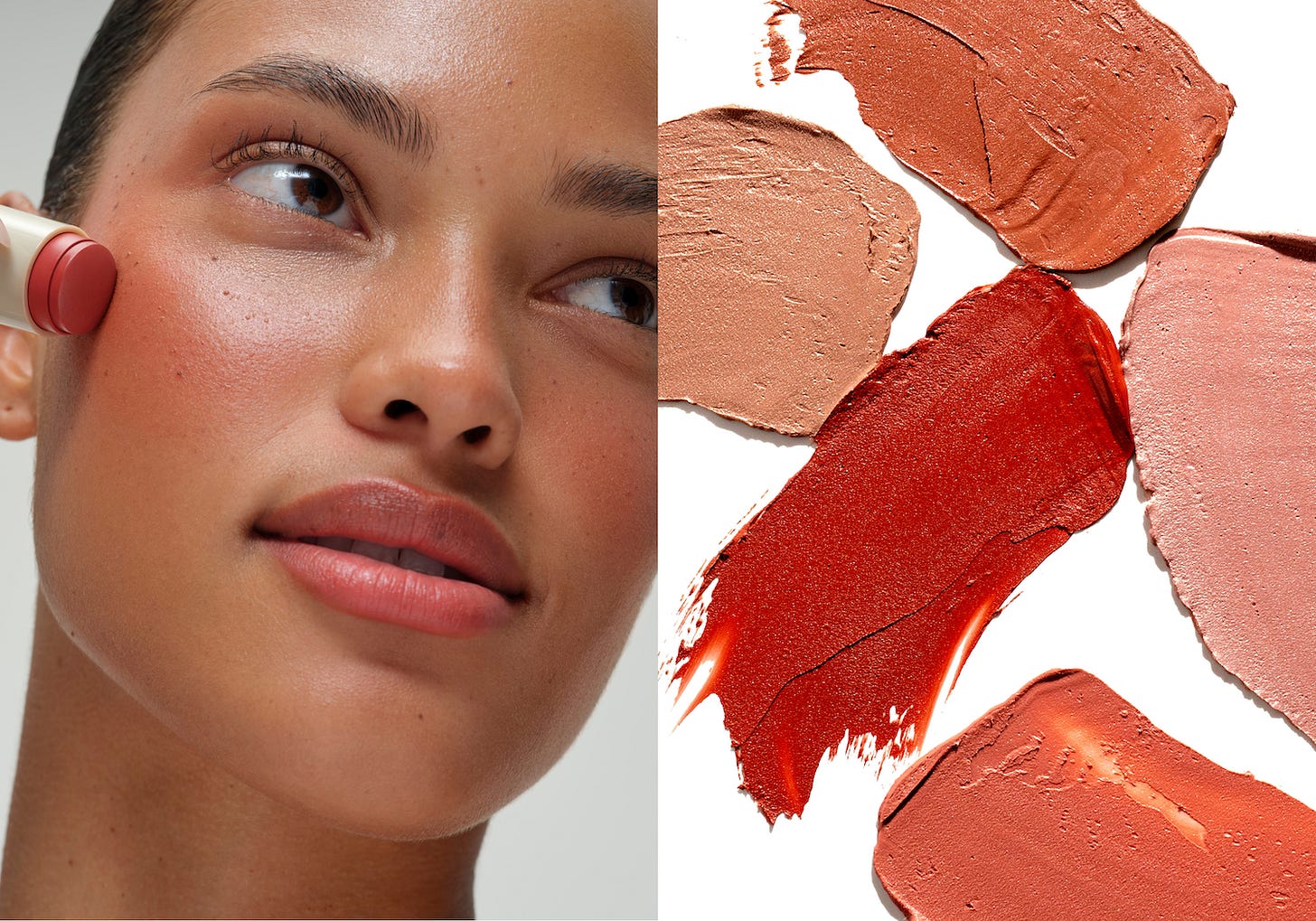
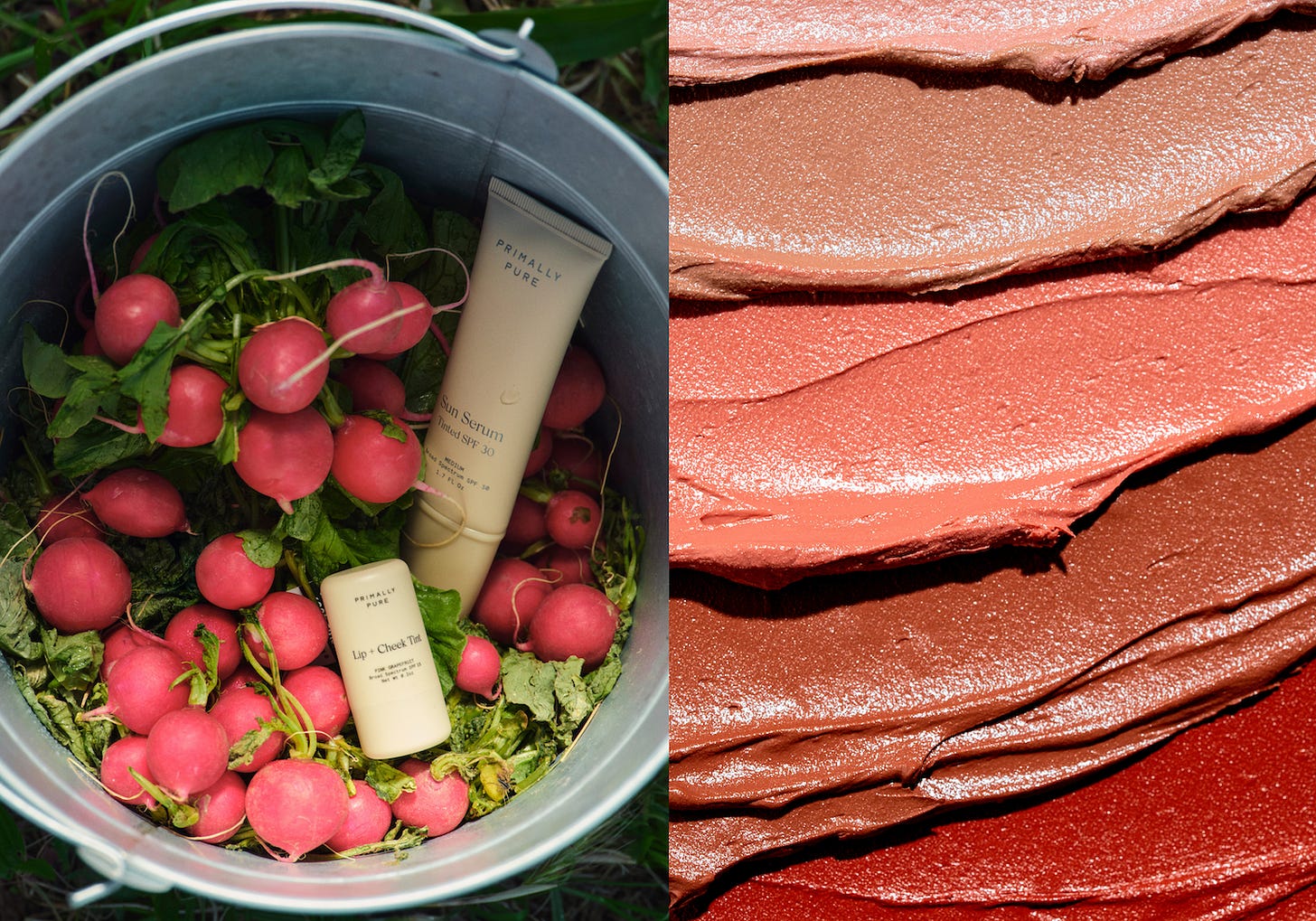
Five shades. Hazelnut, Cinnamon, Pomegranate, Hibiscus, and Pink Grapefruit. The active is Zinc Oxide 10%. The base is the same across all five, with two variations.
The shared base: Organic Coconut Oil, Organic Beeswax, Caprylic/Capric Triglyceride, Tallow from 100% Grass-Fed Cows, Organic Mango Butter, Organic Jojoba Oil, Organic Coconut Extract, Astaxanthin, Organic Sea Buckthorn Oil, Tocopherol (Non-GMO Vitamin E), and Iron Oxides.
Cinnamon and Hibiscus add Castor Oil for a slightly glossier finish. Pink Grapefruit adds Mica for a brighter pigment payoff.
Line by line, this is one of the shortest and cleanest tinted lip-product INCIs on the market. No silicones. No dimethicone. No PEGs. No synthetic fragrance. No phenoxyethanol. No carmine. The tallow and the seed oils carry the pigment. Astaxanthin and Vitamin E handle oxidation. The iron oxides do the color work.
The pigment layer is where the formula audit slows down.
Iron oxides are mineral pigments and they are the single highest heavy-metals contamination risk in any mineral makeup formula. The pigments themselves are inert. The supply chain is not. The FDA’s own guidance on lead in cosmetics flags color additives as the primary route of lead contamination in finished products. A clean ingredient list does not guarantee a clean batch. Third-party heavy-metals testing does.
The mica in Pink Grapefruit is a second open question. Mica supply chains are linked to child labor in Indian and Madagascan mines unless the supplier is certified by the Responsible Mica Initiative or the mica is synthetic. Primally Pure does not publicly disclose which mica supplier they use. Neither do most of their competitors, but on a brand that publishes a “From Our Regenerative Expert” field-notes column, the omission stands out.
The Ingredient Audit — Sun Serum Tinted SPF 30
Four shades: Light, Medium, Tan, Deep Tan. The active is Zinc Oxide 25%.
That number is the headline. For context: ILIA Super Serum Skin Tint SPF 40 is roughly 12% zinc. Saie Sunvisor SPF 35 is around 21%. Kosas DreamBeam sits near 16%. A 25% zinc load on a tinted mineral SPF is genuinely uncommon, and it is the formulation move that makes broad-spectrum protection at SPF 30 possible without any synthetic UV filters in the mix.
The full inactive list, in order: Caprylic/Capric Triglyceride, Organic Beeswax, Tallow from 100% Grass-Fed Cows, Castor Oil, Green Algae Extract, Organic Mango Butter, Organic Jojoba Oil, Astaxanthin, Bakuchiol, Organic Borage Seed Oil, Organic Camellia Seed Oil, Organic Moringa Seed Oil, Karanja Seed Extract, Organic Raspberry Seed Oil, Kakadu Plum Seed Oil, Tocopherol, Organic Sea Buckthorn Seed Oil, and Iron Oxides. Medium, Tan, and Deep Tan shift the order slightly but use the same ingredients.
A few of these deserve a closer look.
Bakuchiol. A plant-derived retinol alternative. Most retinoids photosensitize the skin, which is the whole reason dermatologists tell you to use them at night. Bakuchiol does not. Cleveland Clinic confirms bakuchiol does not thin the stratum corneum and does not increase UV sensitivity. Putting it in a daytime SPF is actually a sophisticated formulation choice. You get the anti-aging benefit without the tradeoff.
Karanja Seed Extract. This one I want to flag clearly. Vendor technical data sheets market karanja oil as a natural SPF booster with a standalone SPF of 16. But the FDA does not recognize karanja as an approved sunscreen active. The SPF 30 rating on this product comes from the zinc oxide. Karanja is included for its antioxidant and barrier benefits. Primally Pure does not claim karanja as a UV filter, and they are correct not to. But if you have seen karanja marketed elsewhere as a “natural sunscreen,” that is the gap between supplier marketing and FDA reality.
Kakadu Plum Seed Oil. The highest natural concentration of vitamin C of any food source on earth. Per the brand’s Substack, it is wild-harvested from “remote regions of Australia” in “nutrient-poor, semi-arid areas without irrigation or cultivation.” Defensible sourcing, real antioxidant payload.
The seed oil stack. Borage, camellia, moringa, raspberry, sea buckthorn. Five antioxidant oils layered into one formula. This is genuinely premium ingredient density for a product in the $40-70 range.
And the same iron oxide caveat applies. The pigment is the contamination-risk vector.
The Sourcing + Manufacturing Reality
This is where the brand outperforms almost everyone in the category.
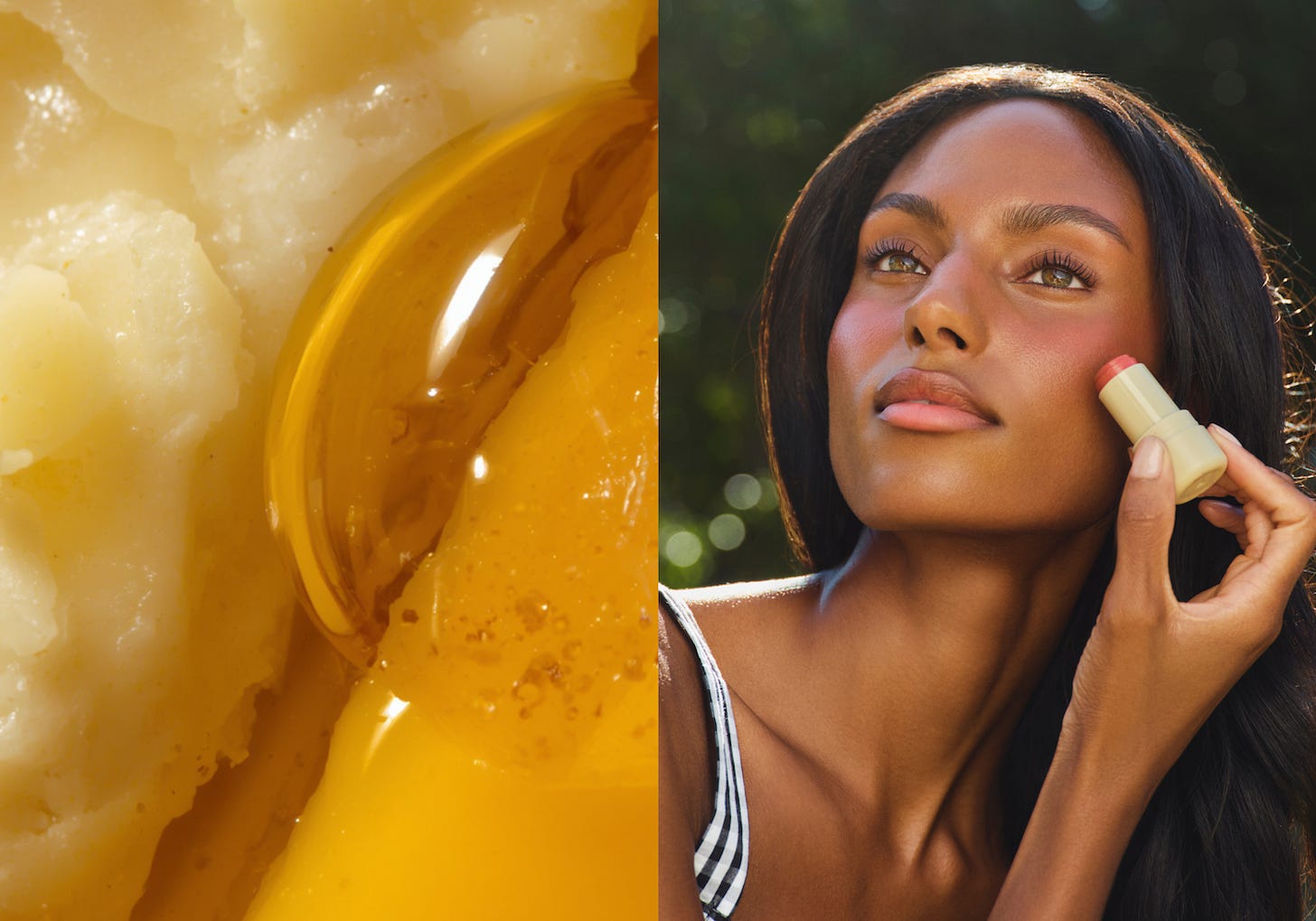
The tallow is sourced from grass-fed, grass-finished cattle at a 200,000-acre regenerative ranch in Montana — Sinton & Sons Ranch — sourced through the brand’s family connection to Primal Pastures, the Murrieta, California farm co-founded in 2012 by Bethany McDaniel’s husband Jeff, his brother Rob, brother-in-law Paul Greive, and their father Tom. Per the brand’s October 2025 video from the Montana farm and Bethany’s April 2026 Instagram post: “Ours is mindfully sourced from grass-fed + finished, pasture-raised cows from farms here in the U.S. — including my family’s regenerative farm, Primal Pastures.”
That is real chain of custody. The founder is married into the farming family. The ranch is named. The rancher (Daniel Sinton) is named on camera. Most tallow skincare brands will not tell you the country the cow lived in. Primally Pure shows you the farm.
The Substack post also names the rest of the team. Tommi is the formulator. Kelsey is the regenerative agriculture lead. Courtney is the in-house esthetician. The brand manufactures in-house in Southern California rather than white-labeling from a contract manufacturer, which means they control the process end to end. Per King Tallow’s independent review: “They’re based in Southern California and manufacture in-house rather than white-labeling from contract manufacturers. That’s worth noting because it means they control their process end to end.”
The botanical sourcing is hedged but honest. Per the Substack: “We make it a priority to source regeneratively” but “it’s not practical to expect all agricultural ingredients to be sourced regeneratively at this time in the amount or quality we need” so the brand “relies heavily on certified organic & wildcrafted ingredients.” That is a more truthful posture than most “clean” brands take. It admits the limit instead of pretending the limit does not exist.
So the sourcing pillar is the strongest of the four. Tallow is fully disclosed and visible. Botanicals are organic or wildcrafted with an honest caveat. Manufacturing is in-house and controlled.
The Third-Party Testing Reality
Here is where the audit gets harder.
Primally Pure has done one significant piece of testing on the Sun Serum: an 8-week clinical study on 31 women aged 43-65 across a range of skin tones, with instrumental measurement of hydration and elasticity, expert clinical grading of fine lines and firmness, and a passed HRIPT (human repeat insult patch test) for sensitive-skin tolerance. That is more clinical work than most clean brands fund. It is real, and it earns the brand the “clinically tested” line on the product page.
What is missing is heavy-metals testing.
The brand does not publish third-party heavy-metals or contaminant testing on either of these two SKUs. They also do not publish it on their existing Sun Cream SPF 30. This matters because in July 2025, Tamara Rubin of Lead Safe Mama published an independent report stating that the existing Primally Pure Sun Cream SPF 30 — the sister product to these new launches — “tested positive for concerning levels of two substances known to be poisonous to humans.” Rubin’s lab only tested for four toxicants. The specific substances and the measured concentrations were not published in the public post. The brand has not publicly responded to the finding.
I want to be careful here. Lead Safe Mama is a high-volume independent tester whose reports have prompted brand reformulations across the industry. The finding is real. The lack of published numerical data is also real. Both things are true at once. A reader doing their own due diligence should know the report exists. The reader should also know the brand has the opportunity, and the means, to respond with a counter-test.
So here is the honest summary: the formulas are clean on paper. The sourcing is best-in-class. The clinical work is real. But the testing pillar has a gap, and the gap has a name on it.
The Fair Marrow Standard Rating
Per The Fair Marrow Standard framework, both products land in the Silver-leaning-Gold tier on the strength of the ingredient list and the sourcing transparency. Neither earns a clean Gold rating today because of the open testing question.
The Lip + Cheek Tint SPF 15 is Silver. The pigments are the contamination vector. The mica in Pink Grapefruit is the open sourcing question. SPF 15 is supplemental sun protection, not primary.
The Sun Serum Tinted SPF 30 is Silver-leaning-Gold. The 25% zinc load, the bakuchiol-in-SPF formulation, the clinical study, and the seed oil density are all real wins. The Lead Safe Mama finding on the sister product is the asterisk.
Either product could move to a clean Gold tomorrow. The brand would need to publish one third-party heavy-metals test on the new SKUs, confirm non-nano zinc on the new product pages (the Sun Cream page states it; the new pages do not repeat it), and disclose the mica supplier on Pink Grapefruit. That is three documents. Not a reformulation. A disclosure update.
The Verdict
Yes, with one caveat. These are the cleanest tinted mineral SPFs on the U.S. market right now on a pure-formula basis. Better INCI than ILIA, Saie, Kosas, Tower 28, or Beautycounter on every metric I tested. The 25% zinc load on the Sun Serum is a real formulation achievement. The tallow chain of custody is best-in-class. The clinical work is real.
The caveat is the testing gap. If you are buying these products to avoid heavy-metal exposure specifically — and that is the single biggest reason most readers come to a site like this one — the brand has not yet given you the document that closes the loop. The Lead Safe Mama finding on the sister product is unresolved.
I personally, in my opinion, think this is one of the strongest mineral makeup launches of the year. And I also think the brand owes its own customers a third-party metals report on the new SKUs. Both things are true.
Fair Marrow may earn a small commission if you buy through these links. Our picks are based on ingredient audits and SDS review, not who paid us. Full disclosure here.
If you want to try either product, both are direct from Primally Pure’s Lip + Cheek Tint SPF 15 and Primally Pure’s Sun Serum Tinted SPF 30 pages. Worn-test follow-up is on the calendar for late summer.
FAQ
Is the Primally Pure Sun Serum Tinted SPF 30 non-nano zinc?
So the brand’s existing Sun Cream SPF 30 page states non-nano zinc explicitly. But the new Sun Serum Tinted SPF 30 page does not repeat that claim. And the launch Substack post does not state it either. The likely answer is yes, but the brand has not publicly confirmed it on the new SKU. Worth asking before you buy.
What is the Lead Safe Mama finding on Primally Pure?
So in July 2025, independent tester Tamara Rubin reported that Primally Pure’s Sun Cream SPF 30 — not the new tinted launches — tested positive for “concerning levels of two substances known to be poisonous to humans” out of four toxicants tested. The specific substances and concentrations were not published. The brand has not publicly responded.
How does Primally Pure Sun Serum Tinted SPF 30 compare to ILIA Super Serum Skin Tint?
So Primally Pure runs 25% non-nano zinc oxide. ILIA runs roughly 12% non-nano zinc with niacinamide. Primally Pure adds bakuchiol, tallow, and a five-oil antioxidant stack. ILIA uses silicones for slip. On ingredient cleanliness, Primally Pure wins. On finish and shade range, ILIA still has the lead.
Is bakuchiol safe in a daytime SPF?
So yes. Per Cleveland Clinic and a 2019 study in the British Journal of Dermatology, bakuchiol performs like retinol on fine lines and elasticity but does not thin the stratum corneum and does not increase UV sensitivity. It is one of the few anti-aging actives that is actually safe to wear during the day, which makes it a logical inclusion in a tinted SPF.
Does Karanja Seed Extract provide SPF?
So no, not in any FDA-recognized sense. Karanja vendors market it as a natural SPF booster with a standalone SPF of 16, but the FDA does not list karanja as an approved sunscreen active. The Sun Serum’s SPF 30 rating comes entirely from the 25% zinc oxide. Karanja is included for its antioxidant and barrier benefits, not as a UV filter.
Where does Primally Pure source their tallow?
So from grass-fed, grass-finished cattle at a 200,000-acre regenerative ranch in Montana — Sinton & Sons Ranch — sourced through the brand’s family connection to Primal Pastures, the Murrieta, California farm co-founded by founder Bethany McDaniel’s husband and his family. The chain of custody is on camera in the brand’s October 2025 farm-visit video.


